
The Rolling Stones started as a cover band, and grew into a completely self-contained rocknroll unit. From 1962 to this very day, the Stones have outlasted the Beatles by many years, who they aspired to be like in the early days. This mix presents in chronological order the early original songs of the Stones, many of them written under the collective pseudonym Nanker Phelge.
It was Brian Jones’ idea to use this name- the whole band would share writing royalties, along with Andrew Oldham and in a few cases pianist Ian Stewart. Phelge was the last name of a roommate of Brian, Mick and Keith when they shared an apartment in Edith Grove, London, as the band was starting out. A ‘Nanker’ was a hideous face that they would make, especially Brian. (image below.)
Several of these songs were instrumentals, and listening to this particular mix of songs shows their development, pre-Jagger Richards. Andrew Oldham had big dreams for the Stones, and his influence on the band cannot be overestimated. As my previous post (Rolling Stones- Cover Band, Pt. 1) points out, their early strength was in their choice and interpretation of cover songs- blues, RnB, rocknroll, country and pop- but Andrew had worked for the Beatles prior to discovering the Stones, and he knew that their future must include original material, so, he pushed Mick and Keith to begin writing.
It’s conjecture to wonder if the Stones would have become the greatest rocknroll band in the world on the strength of these early original songs alone- their ability as a cover band carried them to the point where they could develop their songwriting to compete with and even surpass the Beatles.
It’s also debatable whether Andrew was grooming his own version of Lennon-McCartney by pushing Mick and Keith to write outside of Nanker Phelge, thereby shoving Brian and Ian Stewart aside. This fact, along with Brian’s personal insecurities, psychological problems, and later, his drug use and persecution by crooked British policemen, would eventually drown out his amazing talent and force him to leave the band he started. Ian Stewart was a key member and architect of the Stones sound, and although he stayed on as piano player extraordinaire for many years, early on he was demoted to road manager. Andrew decided that Ian’s look wasn’t cool enough for the image he had in mind.
Andrew’s idea was to present the Stones as the antithesis of the Beatles, and early press was generated to paint them as the bad boys of pop. Lennon-McCartney also provided them with their second single and their first hit- I Wanna Be Your Man, with the first Nanker Phelge release as the B side.
It was cover songs that broke the Stones into pop success- Not Fade Away was their second major hit in the UK, written by Buddy Holly, with a fantastic two chord intro that Keith came up with. Their first UK #1 hit was It’s All Over Now, written by Bobby Womack, and the second #1 was Little Red Rooster by Willie Dixon- this was the height of Brian’s dream- the Stones had put an authentic blues song on top of the pop charts. In the U.S., their cover of Time is On My Side made it to #6 in late 1964.
In early 1965 The Last Time was the first Jagger Richards UK #1, and they never looked back. Of course, today the Rolling Stones are synonymous with Jagger Richards, but it wasn’t always that way.
- Stoned– Nanker Phelge. 10-7-63 This was the first ‘original’ composition released by the Stones, as the B side of I Wanna Be Your Man. It is very similar to Green Onions by Booker T and the MG’s- punctuated by an occasional lyric by Mick at the end of each phrase, this tune also prominently features Ian Stewart on piano. The double entendre of the title has nothing to do with marijuana- this was well before British pop stars were smoking it.
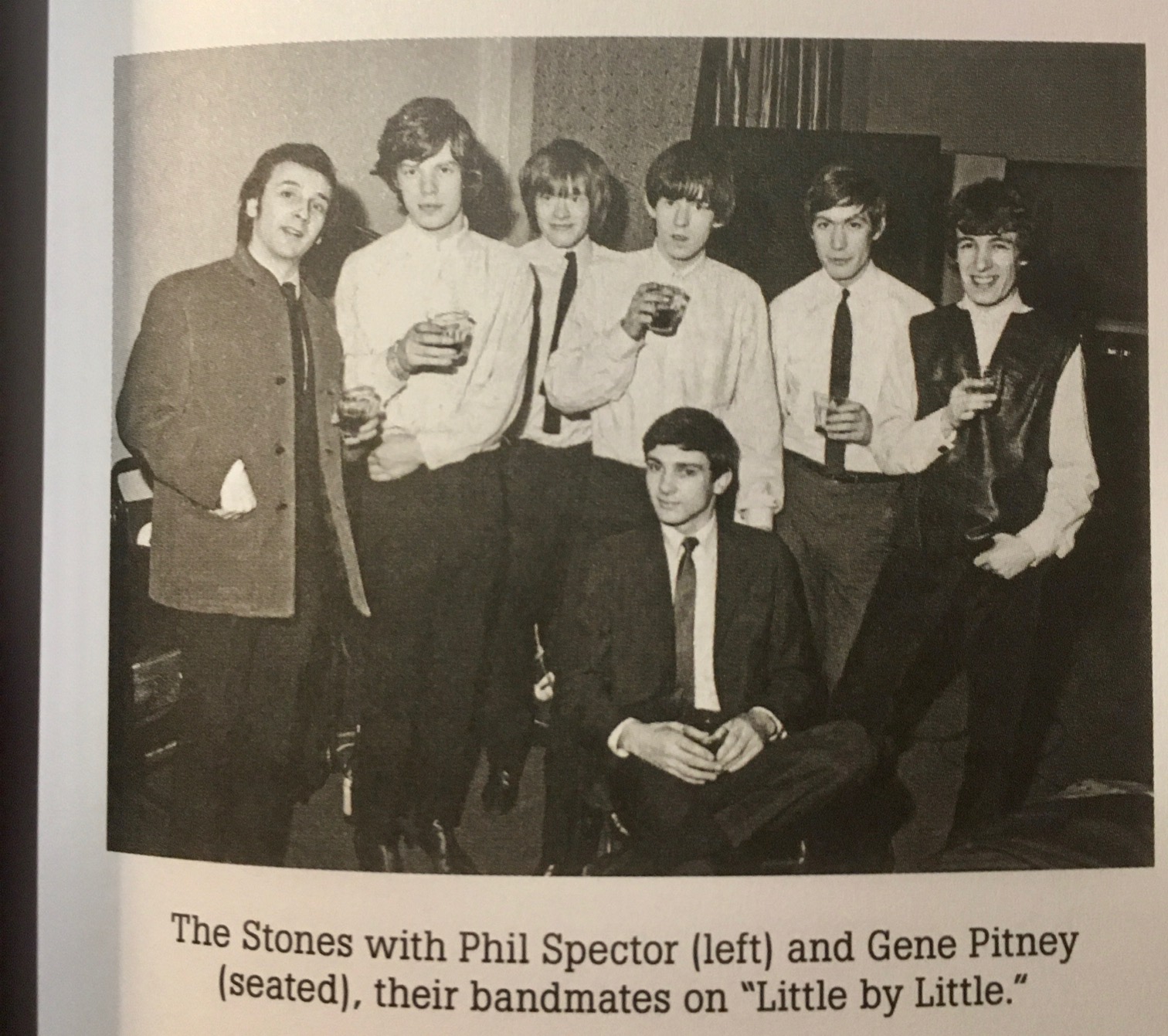
- Now I’ve Got A Witness (Like Uncle Phil and Uncle Gene)– Nanker Phelge. 2.4.64 Another instrumental, with Ian Stewart on organ this time. The title references the fact that it was recorded right after “Can I Get A Witness” by Marvin Gaye. Gene Pitney and Phil Spector assisted on the recording.
- Little By Little– Nanker Phelge, Phil Spector. 2.4.64 The B Side to Not Fade Away, this is their first original song to feature actual lyrics, although the music seems to borrow heavily from several blues songs.
- Andrew’s Blues– Nanker Phelge. 2.4.64 This bawdy bootleg was sung by Gene Pitney and Mick Jagger- the lyrics outline Andrew’s sexual proclivities, and so it was never considered for official release. Graham Nash and Allan Clarke sing background vocals.
- Tell Me– Jagger Richards 2.4.64 The second song credited to Jagger Richards, here we see the roots of their songwriting partnership. Andrew Loog Oldham prevailed upon them to write their own songs, seeing how Lennon and McCartney were a self-contained song machine. The story goes that Andrew locked them in their apartment and wouldn’t let them out till they had written a decent song. Andrew’s influence was huge, although it’s a shame Brian wasn’t pushed along with Mick and Keith. Brian’s only songwriting credits with the Stones are as part of Nanker Phelge. Tell Me was featured in the movie Mean Streets in the early 70’s, and was originally released on their first full length LP, The Rolling Stones, in 1964.
- Good Times, Bad Times– Jagger Richards 2.24.64 Another blues-based original, this one features Keith on 12 string acoustic guitar and Brian on harmonica. It was the B side of It’s All Over Now.
- Congratulations– Jagger Richards 5.12.64 An early ballad, which has a similarity to Good Times by Sam Cooke, hints at the cynical approach to songwriting that Mick and Keith would further develop, in line with their public ‘anti-Beatles’ stance. Of course, this was only Andrew Oldham’s ploy to have a pop group that didn’t compete with the Beatles, but rather would be ‘bad’ where the Beatles had a squeaky clean ‘good’ image. Keith again plays 12 string acoustic guitar, including a barely passable solo. First released as the B side to Time is On My Side.
- Surprise, Surprise– Jagger Richards 5.12.64 This was originally released on a non-Stones compilation LP in England, and was later included on the American release The Rolling Stones, Now! Another cynical ‘love’ song, showing their slow but steady development as writers.
- Empty Heart– Nanker Phelge 6.11.64 Barely more than a single repeated chord progression, this is a full band creation with everyone contributing- Brian on guitar, harmonica and possibly backing vocals; Bill and Charlie as the churning rhythm section; Ian Stewart on B3 organ; Mick on vocals; and Keith on lead guitar and backing vocals. This song has a definite similarity to the Pretenders’ song Middle of the Road, especially the background vocals.
- 2120 South Michigan Avenue– Nanker Phelge 6.11.64 Recorded at Chess Studios in Chicago, the title of this instrumental is the street address of the studio. Brian takes a fantastic harp solo, worthy of any classic Chess recording. The instrumentation is similar to the previous track, adding Mick on tambourine.
- Off the Hook– Jagger Richards 9.2.64 A bouncy, humorous stab at songwriting, with a triple entendre- the song itself has a hook, the phone is off the hook, and his girlfriend seems off the hook too- maybe she’s sleeping, maybe her phone is disconnected, maybe she’s with someone else. Originally released as the B side to Little Red Rooster, the Stones performed a more rocking version of it on the TAMI Show. I can’t wait for this song to be sampled by an RnB artist.
- Grown Up Wrong– Jagger Richards 9.28.64 Led by Brian’s slide guitar, this tune has a somewhat uneven rhythm- but they’re getting there! Again, the subject matter is slightly negative, in direct contrast with the Beatles early output.
- Heart of Stone– Jagger Richards 11.2.64 This is the first truly great song written by Mick and Keith. Their misogynist lyrics are clearly displayed, and this is in line with many Jagger Richards songs to come.
- What A Shame– Jagger Richards 11.8.64 Another bouncy number, with a slightly skewed subject matter- “You might wake up in the morning, find your poor self dead.”
- The Last Time– Jagger Richards 1.18.65 Keith said this was the first song they were happy to bring to the band- and it also became their first self-penned #1 single in England. Various people have noted a similarity to a gospel song done by The Staple Singers called This May Be The Last Time, but Mick and Keith merely used this as a starting point, and came up with a truly original spinoff. The guitar hook was written and played by Brian Jones.
- Play With Fire– Nanker Phelge 1.18.65 It’s odd that the songwriting credit for this one went to Nanker Phelge, since only Mick and Keith (with Jack Nitzsche on harpsichord) appear on the recording. A classic song with a dark overtone, showing their growing talent and foreshadowing the slightly medieval approach to pop songs they would become famous for. Released as the B side to The Last Time.
- The Under Assistant West Coast Promotion Man– Nanker Phelge 5.10.65. I hear Bob Dylan and Ray Davies’ influence on this tribute to the ‘suits’ that worked at record labels in the mid-sixties. Featuring the classic early Stones lineup with Brian on harmonica and Ian Stewart on piano, this is the last song credited to Nanker Phelge, the B side to the Satisfaction single in the U.S.
- (I Can’t Get No) Satisfaction– Jagger Richards 5.12.65 This is the Stones watershed moment- the single went to #1 in the UK, the U.S., Germany, the Netherlands and Australia. From this point on, they were in a league of their own- Beatles, Kinks and The Who notwithstanding. Keith came up with the riff in a motel room in Florida while on tour- he woke up from a deep sleep with the riff in his head, turned on his cassette recorder and laid it down. The next morning, there was 2 or 3 minutes of the riff on the tape, followed by 40 minutes of him snoring! Mick came up with the lyrics while sitting at the motel pool the next day. Keith was initially against releasing it as a single- he thought their version was more of a demo, and that the riff should be played with horns. Luckily he was outvoted by the rest of the band, and after he started hearing it on the radio constantly he was not displeased. When he heard Otis Redding cover it with horns later that year, he thought Otis had gotten it right. It was also a turning point for Brian Jones, as he saw Mick and Keith usurp his role as leader of the band.
- The Spider and The Fly– Jagger Richards 5.12.65 Even at this early stage, the Stones had a knack for writing new songs that sounded like old blues. The guitar interplay between Brian and Keith is still very strong at this point- their playing is nearly indistinguishable till Keith takes his solo. Mick had been taking harmonica lessons from Brian, and it shows. First released as the B side to Satisfaction in the UK.
- One More Try– Jagger Richards 5.12.65 Unreleased in the UK until the Stone Age compilation in 1971, this was released in the US on Out of Our Heads.
- Get Off of My Cloud– Jagger Richards 9.5.65 With the Dylan influenced lyrics deliberately buried in the mix, Mick continues his description of the pop star alienation the Stones were starting to resent, begun with Satisfaction. Released as a single in October 1965, it reached #2 in the U.S. and UK.
- Gotta Get Away– Jagger Richards 9.5.65 Ditto for this one. Jagger was learning that it wasn’t so much what he sang, but how he sang it. Listen to how he leans on the word Baby. Brian must have been listening to the Byrds during this time, as he uses a 12 string electric guitar.
- The Singer Not The Song– Jagger Richards 9.5.65 The title says it all. Keith sings excellent harmony- something he rarely gets credit for- although this tune doesn’t quite make it, perhaps because of Mick’s sloppy falsetto parts. Notice how at the end of the second line of each verse we hear only Keith’s voice- “babe you know,” “thrilling me,” “much too long.” The jangly folk rock sound again is courtesy of Brian’s electric 12 string Rickenbacker guitar. Released as the B side to Get Off Of My Cloud.
- Blue Turns to Grey– Jagger Richards 9.5.65 Another Byrds-like tune, a rare thing in the Stones catalog. Originally released in the US on December’s Children, this was not released in the UK until 1971, on the Decca compilation album Stone Age.
- I’m Free– Jagger Richards 9.6.65 The lyrics show Mick and Keith’s resilience in the face of the pressures of stardom- whereas Brian internalized it and suffered from it, they were able to stay free.
- As Tears Go By– Jagger Richards 10.26.65 This is the first song that Mick and Keith wrote together, even though along with Andrew they initially felt it was not suitable for the Stones to record, and instead gave the song to Marianne Faithfull, who had a hit with it in 1964. Mick and Keith eventually recorded it without the rest of the band, with strings arranged by Mike Leander. Released as the B side of 19th Nervous Breakdown in the UK.
- 19th Nervous Breakdown– Jagger Richards 12.8.65 Another song about the crushing effects of touring and pop star alienation, this also seems to refer to Brian’s deteriorating mental state. The two guitar interplay is very strong here, with Keith adding a distorted riff at times. Released as a single in February 1966, this made it to #2 in the UK and U.S.
- Sad Day– Jagger Richards 12.9.65 An underrated song that would have fit comfortably on the Aftermath album. The American B side to 19th Nervous Breakdown.
- Paint It, Black– Jagger Richards 3.6.66 The only song on this mix recorded in 1966, Paint It, Black originally did not feature this odd, Turkish sounding rhythm. After several unsuccessful stabs at recording it, Bill Wyman started playing the chord changes on an organ with a mad, churning rhythm, poking fun at their former manager, Eric Easton, who at one time was the organist in a cinema pit. Charlie picked up on the rhythm, and Brian added the distinctive sitar part. Bill assumed this would be credited to Nanker Phelge because of each band member’s input, but he was surprised and disappointed when the single was released and credit for the song went to Jagger Richards.
It’s odd that halfway through the recording of Aftermath, starting in 1966, Brian sort of refused to play guitar with Keith anymore. Several tracks on the album feature his guitar and harmonica playing- especially Mother’s Little Helper, Doncha Bother Me, Goin Home, and It’s Not Easy- all but one recorded before the end of 1965. During these sessions Brian would disappear for days at a time, although Keith noted later that Brian’s diverse contributions on dulcimer, marimba, vibraphone, sitar, recorder, mellotron and piano were spot on when he did show up.
Most of their next two albums, Between the Buttons and Their Satanic Majesties Request (both released in 1967) still feature Brian prominently, but in a more isolated role, and usually not on guitar- Brian was fading away, and his last real contribution to the band would be on Beggars Banquet in 1968, notably his poignant slide guitar on No Expectations.
The success of Satisfaction put the Stones into the pop stratosphere, but it also did away with Nanker Phelge, and took Brian’s band away from him.

 Jeff Sanchez - Words and Music